Judo technique
Kata-gatame
Learn the basics of Kata-gatame and its two variants.
Meaning
Shoulder hold
Pronunciation
kah-tah gah-tah-meh
What this technique covers
What the name means
Kata-gatame means Shoulder hold in Judo.
Classification
- Type
- Katame-waza: Grappling or control techniques
- Subtype
- Osaekomi-waza: Holding techniques
Key idea
The first idea is control: recognize the hold-down shape, the position of tori and uke, and why this position matters in osaekomi situations.
What to notice in the image
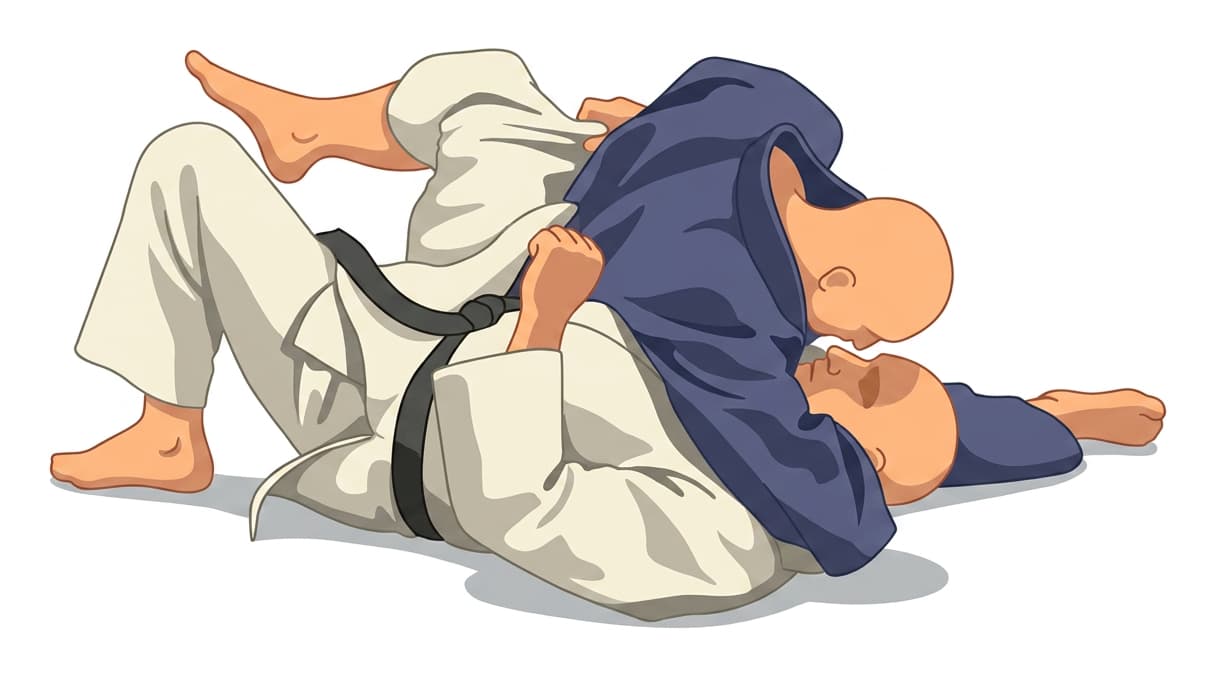
In Kata-gatame, uke's own arm is pressed against the head while tori closes a ring around arm, head, and shoulder. Pay special attention to how tori creates control and where uke is positioned in relation to tori's body.
What you will learn
- Recognize the name Kata-gatame
- Understand the arm pressed against the head
- Recognize the kneeling and sitting variants
Key terms
- Kata-gatame
Shoulder hold
Kata-gatame pins uke by pressing uke's own arm against the head. Tori closes a ring with both arms around uke's arm, head, and shoulder.
- Kesa-gatame
Scarf hold
Kesa-gatame is a common pin. It uses chest pressure and arm control rather than squeezing with strength.
- Osaekomi-waza
Holding techniques
Osaekomi-waza are pins used to control an opponent on their back or side during groundwork.
- Osaekomi
Hold-down is on
Osaekomi is called when one judoka pins the other with control. The hold can score if control continues long enough.
Good to know
- Katame-waza: Grappling or control techniques
- Katame-waza are control techniques, including pins, strangles, and arm locks. This curriculum introduces holding ideas first.
- Osaekomi-waza: Holding techniques
- Osaekomi-waza are pins used to control an opponent on their back or side during groundwork.